.jpg)
This is a resource link for anyone looking for English news sources in Taiwan. Radio Taiwan International has resources that are often only found in Chinese, and this blog has links to listening to RTI's Chatroom program, as well as major happenings around Taiwan.
For example, be sure to check out the RTI Chatroom Art Taipei 2008 post for information on the exhibit at the Taipei World Trade Center this weekend.
Thanks to the crew over at RTI for their efforts on this useful resource!
Showing posts with label Taipei. Show all posts
Showing posts with label Taipei. Show all posts
Thursday, August 28, 2008


Monday, August 4, 2008
Taoist Dance
I have lots of photographs from Taoist dance performances from the troupe at the temple (松山慈惠堂) we attend regularly. The group of women perform all over Taiwan (and internationally), and so we often have karaoke bus rides down South with stops at large vegetarian mess halls and host temples on the weekends.
There should be a real post to do it justice, but here's a shot from a recent performance.

There should be a real post to do it justice, but here's a shot from a recent performance.

Sunday, July 13, 2008
Stormy Weather
At least in Northeastern Taiwan, most mornings are hot, sweaty and sticky by 8am, and run so until just after lunch, where a breeze tends to kick in and the static in the air feels like storm. If it doesn't rain for a few hours (or at all that evening), there tend to at least be heavy clouds, and hopefully an accompanied cool-down.
Here are two shots of some weather.
****Taipei Gongguan MRT stop, 3pm 下午三點台北捷運公館站****
 ****View of Turtle Island and Yilan while getting on Provincial Highway 9, the mountain road to Taipei 從往台北九號省道看龜山島****

Here are two shots of some weather.
****Taipei Gongguan MRT stop, 3pm 下午三點台北捷運公館站****
 ****View of Turtle Island and Yilan while getting on Provincial Highway 9, the mountain road to Taipei 從往台北九號省道看龜山島****
Sunday, May 18, 2008
Turtle Begging

I was recently invited by a friend to a high-end temple in Linkou for their "Turtle Begging" event.
Turtle Begging is Taoist tradition in Taiwan that takes place in the Spring. During this time people can come and "beg" for peace, luck, or fortune (monetary) in the following year. If they win turtles, they bring them home along with the implied fortunes.
The day has a typical prayer/chanting session as held every two weeks (1st and 15th of the Lunar Month). As typical, you can bring fruit and other food (at least 3 different types of food for each tray) for blessing. Atypically, today you are supposed to bring new clothing for blessing.
****Food for Blessing****


This is followed by an afternoon of gambling. Catholics and their Bingo can rest their hearts a little.
To Beg for Peace and Luck:
1. Select the Kind of Turtle you wish to beg for:
-1斤, 2斤, 3斤, 5斤, 10斤
-These are made of different food items, such as pastries and jello-like packages
2. Nab two red crescent-moon shaped wooden blocks (don't remember the actual name for these items):
-These are used often in Taoist temples for asking advice. If you have a question, you pose the question and drop the blocks. 1 face down and 1 face up mean "yes, I can answer", 2 down or 2 up means "nope, not ready to answer". If yes, take a stick with a number on it. Repeat the first steps to make sure that the number you have is the right one, then take a slip of paper with words of wisdom intended to answer your question. Finally, see the temple interpreter who knows what the saying actually means.
3. Introduce yourself to the Deity, name and location.
4. Pose your request:
-"I wish for peace in x斤" and make a promise "
-and I'll return x斤 by giving double what I take next year at this same event, otherwise you'll punish me with un-peacelike thoughts."
-Note: Helps if done in Chinese.
5. Drop your Crescent-Moon Blocks like in item 2
6. Search for the Turtle that calls to you (tastes the best).


7. Tape on your name and turn it around away from the deity to symbolize it's movement towards your home.

6. Take your turtle and sign your name and address so they can track you down for next year's donation.
This I played.
To Beg for Fortune in Business:
1. Pay $1500NT ($45US) to get on the Gambling List
2. Wait for your name to be called.
3. Kneel in front of the Deity.

4. Drop the Crescent-Moon Blocks (with an audience)

5. Get the most 1 up, 1 down sets in each heat.
6. Be declared the Turtle King or Turtle Queen and take home the coin turtles!

7. Take a Golden Snake/Turtle for 2nd-7th places.


8. Promise to give the temple about 三萬 ($1000USD) next year at the same event.
This I didn't play.
The day is capped off with a big dinner, where orphans from a nearby children's home pigged out (strict vegetarians inside the home, they ate a variety of meats this evening, but could not take anything back).
****One shy, one "too-grown-up-for-her-age"****

I tried to do some quick math (haha!). The orphanage had about 50 kids there. About 25 people participated in the high-stakes gambling, and some returned for a second round buy-in after losing, some a third, so I figure about 35 buy-ins at $1500NT a pop. That's $52,500NT (with a sucky US Dollar value these days, that's about $1,750). The dinner (12 courses or so) fed easily 300 people, probably costing about $600NT each, so $180,000NT or $3,000. At least 50 people had trays with new clothing to be blessed, and the same with food. Clothing and food averaging $300NT combined, that's $15,000NT or about $500USD.
Bill for Turtle Begging: $5,250.
What did the orphans get (besides the occaisional scolding by temple go-ers for throwing rocks at dogs or smelling up the Gambling Ring/Temple Doorway)? A meal that conflicts with what organized value system the orphanage can hope to instill (here vegetarianism) and a sugar rush from unlimited cocktail juice (12% juice avg).
Sure some of the money from the day goes to the kids dinner, and I'm sure the temple does other charitable events. But a fraction of the busy people there that afternoon spending half of the time (I put in 7 hours total) one-on-one with some of those kids, what a world of difference it'd be.
I'll repay the "Peace Turtle" I took this year, as required by my promise to myself, the god, and the temple bookies, but next year, I'm begging for some peace through action, by spending my afternoon volunteering at the orphanage.
****Note: this post is not meant to be critical of this temple, Taoism, or Taiwan in particular. Intentions are good all around, I am sure, and there are discrepancies between intention and action and result in every country with every religion****
Tuesday, August 28, 2007
Hiking in Sijhih

“Tony, Tony, Come Around
Something’s Lost and Must Be Found”
-Jules to St. Anthony
Something’s Lost and Must Be Found”
-Jules to St. Anthony
This past weekend was quite eventful, and will thus make up a couple of separate posts.
If you have been a swell reader, then you'll know that the Ghost Festival in the middle of Ghost Month was this past Sunday. Interested in catching some of the festivities, I began discussion with an adviser and friend about how and where to get the best view. She recommended the Keelung (Jilong) Festival, as previously mentioned, one of the largest in Taiwan. Keelung is a harbor town East of Taipei (Northern Taiwan) and about an hour and a half from our homes in Yilan. The Festival was on Sunday night, and so to make a full weekend adventure out of it, we decided to have fun up North on Saturday as well.
9 ETAs went to Taipei for a Tap Dance Performance called Tap Together; it was the culminating performance of a long period of international dancing exhibitions. I am told they had a great time, enjoyed the show and drinks, and the hostel, not so much.
3 of us however decided to take our adviser up on a generous offer. She, with her husband/partner (an apparently common arrangement for Taiwanese not wishing to have children is to remain committed as dinghezu, a term which tells potential pestering friends, parents, and grandparents to quit worrying about future children; hearing “married” tends to incite questions of kids, as this is an extremely family oriented culture, but this term stops even the most curious), own a number of (expensive) homes, including a location in Taipei, one near a river/lake (forget at the moment), and one in Sijhih, a kind of suburb of Taipei, slightly less developed. Hearing that we wanted to head to Keelung on Sunday, she offered for us to crash at her place and do some hiking on Saturday.
We were greeted by her dinghezuren at the Taipei station, who offered us a bag of crackers and cookies, some instructions for hiking, and some gloves for rock climbing. He was on his way to a mandatory temple attendance (Both he and our adviser are Taoist, and though the Festival to which we were heading is significantly more Buddhist, Ghost Month comes with required ceremonies for Taoists as well; in fact, most Taiwanese, whether they formally adhere to a religion or no, follow a mix of religious customs, such as celebrating this festival), and so ushered us into his car, to a small restaurant for some food to go, drove past some cultural sites, entertained us with welcome small-talk and genuine warmth, and then dropped us off at the foot of Xiang Shan 象山 or Elephant Mountain.
The mountain was beautiful. Stone stairs wound up and down and left and right in a variety of networks (I am sure we only traversed a few of them, and were wowed enough by the variety of vistas, scenery, and nature in just over two hours). A large temple stood at the base of the mountain, with speakers blaring recorded chants; the voices sounded female, and despite being rough recordings, very evidently technological and thus out of place in the natural setting, they lent an air of calm mystery to the place that even full daylight and high humidity could not abate). There were temples patchworked all over the mountainside, and trails that branched left and right in various states of less-traveled disrepair (earth- and rain-ruptured blocks curtains of mosquitoes showed that even around temple-side agricultural residences, nature reigns supreme – damn thing reigns over 98% DEET, too, so says my itchy face, arms, and legs).
****Little Guy Outside one of Many Little Temples****

****The mountain was highly populated, with tourists visiting, locals worshiping, farmers living on, and a health-conscious population exercising, such as this man****


****Jules/Michelle at Strategic Lookout****

The main path was easily visible, and though we did not make it to the rock climbing site our new friend had recommended, we did find a magnificent lookout point, where you can full appreciate the size of Taipei 101. Taipei 101 was the world’s tallest building until about a month ago, but it nonetheless is impressive. The perspective is harder to get right below it, but from up here, size it up to the other mammoths of the city, and you know why it’s an item of Taiwanese pride.
****Giant Spider Attacks Giant Building****

The way down, back up, and across lead us through lots of colors and reduced our English to instructional level: “That’s so beautiful! It’s so big! That’s so green! It’s so amazing!” (Dr. Collins would have been proud). Really though, the wonder of the scene was difficult to fully appreciate, even there in the midst of it. Birds were chirping in Taiwanese tongue I’d not yet heard from any wildfowl; faint sing-song Buddhist chants broke around the large boulders off the paths; stray dogs, frogs, giant spiders, and fuzzy golden ants were only some of the animals that most identifiably decorated the woods; there are many times I’ve expressed disbelief that I’m really on this trip, living in Taiwan; this was a time of word-stifling wonder that I could really be in this life, that anything and everything really is alive.
****Jules and some Ferns looking for Sunlight****

Colors:


Taipei is a pedestrian friendly city, and so the walk down from “so amazing” kept the spirits high. We hit Taipei 101(an amazing building that I will have to explore more of during another trip to Taipei; for now I know there’s a large mall with mostly US and European stores, a large foodcourt, and a grocery store with the best (still mediocre) selection of imported beers I’ve found here – finally tried the Belgian Delirium Tremens (Zach and Pat: It not only has the large pink elephant here, but dancing alligators and dragons on circus balls on the label]), and met our adviser/friend who brought us to the essential bubble tea, her lovely apartment (rooftop garden and public space, complete with fluffy bunnies in residence), and then to a Thai restaurant for dinner.
The Thai food was amazing; I particularly enjoyed the "green papaya salad" or "tom sum" (thx, Jules) shaved into thin strips and heavily spiced. Our adviser’s husband (for ease of labeling, see earlier for explanation) met us again and we talked camera shop for a little while.; he published a photography book in Taiwan 30 years ago, instructing a burgeoning upper- and middle-class how to use a flash in outdoor situations, and encouraged me to pursue putting some photos up in a show in Yilan and possibly Taipei.
Dinner also offered the chance to learn a few jokes for Chinese dining. The words for “want rice” sound like the word for beggar, so “wo yao fan” is “I’m a beggar.” You can ask a guest if they “yao fan,” illiciting a smile for sure, and laughter from the rest if they don’t know the joke and agree. Be careful when ordering though; ask the waitress to “qing (please) gei wo fan (gimme rice)” rather than tell her you’re a beggar. Along the same lines, if you eat your rice too quickly, you might be called “fan ton” which covers both the large table rice-bowl and calling someone lightly stupid. Rice on your cheek? Then you “dai bian dang” or “are wearing a lunch-box (typical lunch food),” not dissimilar from our “saving that for later?” These have already become dinnertime hits.
Post-dinner/dessert they brought us to home 2 of 4 in Sijhih, part of a nice gated community for retired folks. The next day involved waterfall hiking (make you wanna drop trou’ and swim waterfalls), Michelle working past a fear of heights, and then meeting the rest of the crew for stage two: Biker Gangs and the Ghost Festival. Check Back Soon.
****Photo Courtesy of Tall Mountain/Hopeful Pearl****

Thursday, August 9, 2007
Typhoon Day in Taipei
Orientation for the past week has been running a little something like this:
8:50: Board the bus by the 7-11 on the corner (you can navigate by 7-11's here, which they call "7's" as in" 你要去7嗎?/You want go 7 ma? - for example, "Turn right at my 7, walk straight down Taishan Lu and turn right into the apartments by the next 7"). The bus is a special education bus, which I hope someone in Taiwan derives amusement from; our group may be more aptly named Foolbrights or Halfbrights (a couple of puns provided by a Vietnamese Fulbrighter back at OU a few months ago).
9:00-12:00: Deal with assorted orientation details. One day was a long discussion about the educational system in Taiwan, certifications for teachers, politics in relation to public schools, etc. We have also been running errands applying for Alien Resident Cards (IDs), Bank Accounts, and SIM Cards for phones.
12:00-1:30: Lunch and emails.
1:30-4:00: More orientation, such as Chinese practice or more errands.
Evenings have been free, but full of tying up loose ends from the orientation bits and returning to destinations pointed out during the day to further explore. Of course, we eat well too.
It's not really as cut and dry as it seems, and this is only for the first week. The next two weeks will involve practice teaching, pedagogical information, and getting to know our co-teachers, with whom we will be paired one-to-one and working exceptionally close with in the following year.
"Be Flexible":
How so not cut and dry? Of course, with any type of program abroad, it is impossible to cover all angles, so there's always some unexpected fun. The immigration office reversed a couple of numbers from my passport, so my ARC is currently invalid and the bank account, not yet acquired. No problem as I have enough cash to float for now and all will come in due time.
The special ed bus also blew out a tire on one bus ride home. Indicative of the great network of relationships that commerce runs on in Taiwan (known as guanxi/relationships), all the driver had to do was wheel it across the road unannounced to the nearest Dunlop place, wait half an hour for the repair, and start her up again. The service industry is infused with cultural attitudes about establishing and maintaining relationships, such that I've heard taking the time to know your scooter salesman creates the opportunity for free repairs on small items in the future.

The group saw this while purchasing cellphones the other day. The Nokia dealer knew he was about to sell 12 phones. Appreciating past and current business with the Fulbright foundation, and hoping for future sales, he was glad to offer discounted prices on phones, present our Foundation advisor with a gift (some phone accessory from off the wall), and offer us discounted minutes all year. Business like that is logical; you keep your customers coming back. However, the formalities such as initially asking a slightly higher price than both buyer and seller know the item would ultimately go for, the buyer offering profuse thanks for the eventual reduction to the final, fair price, and the exchange of personal name cards/mingpian/名片, all work to further personalize a typical purchase. Straight capitalistic exchange does not require much dialogue nor give berth to much creative interaction between the buyer and seller; a burger's a burger and you're looking for 99cents. However, this exchange is one that builds a relationship/guanxi that works out to everyone's advantage.
****Another example: we all purchased bikes from these lovely men who annually give Fulbrighters a great deal, work efficiently to help out with repairs whenever its needed, and buy them back at the end of the year. I'd say not a friendlier couple of guys on the island, but most I've met have been so.****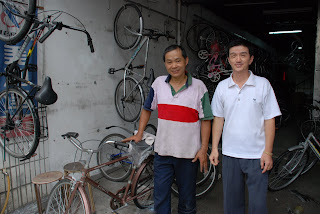
So orientation has been a broad process of settling into Taiwanese culture and visiting relevant locations in the new city well beyond the classroom/handout orientation aspect. Our academic advisor, Dr. Timothy Collins, frequently says that to "be flexible" is the best thing you can do to get along in Taiwan. With that lesson in mind I turn to the topic mentioned in the title.
Typhoon Weather
Taiwan was hit by a couple of typhoons recently(Pabuk: Tuesday/Wednesday and Wutip: Thursday) which were more rain than wind intensive (we broke out the window-tape for reinforcement anyway). Truth is, they missed their predicted mark (Yilan, where we are staying) and ended up further South. Pabuk was mostly rain and Wutip, well I didn't see any of it. We were given the day off from orientation today in preparation for it, and it ended up being splendid weather. Fog days in high school don't compare to getting a beautiful day off because of a predicted typhoon while living in Taiwan.
Taking advantage of the Day Off:
So two days ago we ran internet through the apartment; my two roommates and I spent an unnecessarily lengthy amount of time scratching a computer-itch that had been unspokenly neglected, I'm sure, since all of us began traveling. A few hours of writing, emailing, surfing, and so forthing later, I headed off to bed, leaving my computer up and on (Mitcho, the mac/computer whizz in the house set it up as broadcasting wireless hub for the others to feed from until we purchased a router; fascinating thing number 7,231 I didn't know you could do with this computer).
When I woke up in the morning, the computer was frozen; restarting it presented only a gray screen with a flashing file-folder and question mark on it - a sign that the computer could not find a hard-drive or had some sort of corrupt system file. Mitcho tried a variety of alternative start-up methods, such as booting from an install DVD and running the PRAM startup, all with no success. While I was convinced that the neighbors (heavily tattooed young men, who clearly must be gang members suspicious of us moving in and setting up wireless internet) hacked into my computer and stole my system, Mitcho didn't agree and suggested we go to an Apple store in Taipei. His computer was dealing with screen problems as well, and so we considered this our best chance to wrangle a working computer between us.
The trip to Taipei to fix the computers turned out to be quite an informative and efficient adventure. Mitcho and I had the experience of navigating the train station, riding the hour-forty to Taipei, hopping off and quickly onto the MRT Rail system, finding Xinsheng Zhong Rd and the impressive computer district, and entering the trendy Youth Apple Store.
****Myself with the hanging "mice" in the computer district - reminiscent of hanging duck in restaurant windows. Photo courtesy of mitcho****

Harddrive? What's that? Why would I want one of those?
A young Taiwanese named Bryan tried to turn on the computer twice, and announced quietly "your harddrive's dead. we can give you a new one." Really simple; no fuss; just dead. I asked about recovering data, which he said would run 1,800NT and didn't guarantee they were able to recover anything. After diagnosing Mitcho's trouble, I told him I would like to try to make the recovery. He offered to try for free, and only charge me should recovery of any data be successful, which was great because I was torn about the attempted recovery. Most of everything is backed up in the States. All I really lost were photographs from San Francisco (sorry Shelbs :-/ ) and the first few days in Taiwan, and contact info from my address book (of all things to neglect backing up). Also, all the settings that I used over the past 6 months to personalize my interface are gone, going, gone, everything gone, give a damn.
In some ways, this was quite the bummer, but at the same time, it's quite liberating. My new harddrive is stacked with plenty of applications (almost all that I had personally downloaded myself, plus many I've never heard of). Initially, everything was set in traditional Chinese. I have since reverted most to English, though login pages and some applications are in Chinese only. This is actually a good incentive for me to keep studying. Being here for even this brief amount of time has really enhanced my passion for Chinese; I am determined to learn traditional characters, read an entire menu, and listen and speak with fluency. It may take a while, but I'll get there.
****A little tip for anyone else studying Chinese: start studying traditional! They are tougher characters, but it is much easier going from traditional to simplified than the other way around. Also, check out the Taiwanese phonetic system, bopomofo or ㄣㄆㄇㄈ; it will really help with your pronunciation!****
MRT
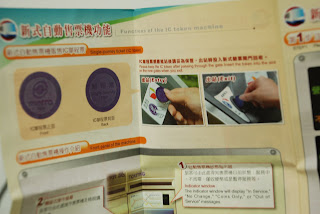
While I left the camera at home, I also left my Taipei MRT card for riding the rails. This meant that I purchased single use chips each time. Jerry (new friend and Fulbright advisor in Taipei) tells me later that these chips are really new, perhaps just a few weeks. It's an interesting system. You pay 20/25/30NT for a blue plastic chip. Apparently it is electronically tagged for just that amount, and it scans as you enter the paid area (past the yellow line where you surely must not chew gum). You just deposit it on your way out and they are reused. Voila. Quite a nifty system.
****Manual for the ultra-new bluechip system; fun-fun****
So, computers taken care of (I walked away with my new harddrive as well as a trendy cover for the keypad that takes care of palmrest smudges - darn white macs - spills and damage, as well as has the bopomofo system written on the keys! ) Mitcho and I enjoyed an excellent dinner at a Korean BBQ restaurant: Seafood Pancake, Kimchi, Steamed Cabbage and Onions, and a plate of lamb and beef. The meat comes out raw and you place it on the grill in front of you, with veggies steaming on the side. Truly one of my favorite ways of eating and a throwback to the Shandong, China trip 3 years ago (a regular staple).
Dinner Gossip
We enjoyed an interesting conversation with Jerry and Ellen from the Fulbright office, learning much about Taiwanese politics (storefront signs can be politicized: stripped down and simple, blue for Kuomintang - Nationalists fled China 1949 post-CCP uprising - and reunification, green for independence - of course, it's never that simple, but you get the gist), Taiwanese friendship (often avoid discussing heavy issues, especially where one could be polarized from your friend, ie, politics, where you can be deep blue, light blue, light green, or deep green), Dr. Wu in the Fulbright office (famous psycholigist - every Taiwanese kid had to read one of his books in middle school - and artist/performer - invented a major dance genre famous in Taiwan), and about where to find the most scantily clad betel nut girls (apparently Yunlin, according to Ellen - why she offered the information, Mitcho and I still are not sure).
****More than likely unintentional, but a lot of green in one place caused me to pull out the camera; I'm seeing color politics in everything now****

So that's the gist of a typhoon day: spectacular weather, good friends, easy travel, excellent food, and so on...I told Mitcho I couldn't imagine being happier to crash a harddrive.
8:50: Board the bus by the 7-11 on the corner (you can navigate by 7-11's here, which they call "7's" as in" 你要去7嗎?/You want go 7 ma? - for example, "Turn right at my 7, walk straight down Taishan Lu and turn right into the apartments by the next 7"). The bus is a special education bus, which I hope someone in Taiwan derives amusement from; our group may be more aptly named Foolbrights or Halfbrights (a couple of puns provided by a Vietnamese Fulbrighter back at OU a few months ago).
9:00-12:00: Deal with assorted orientation details. One day was a long discussion about the educational system in Taiwan, certifications for teachers, politics in relation to public schools, etc. We have also been running errands applying for Alien Resident Cards (IDs), Bank Accounts, and SIM Cards for phones.
12:00-1:30: Lunch and emails.
1:30-4:00: More orientation, such as Chinese practice or more errands.
Evenings have been free, but full of tying up loose ends from the orientation bits and returning to destinations pointed out during the day to further explore. Of course, we eat well too.
It's not really as cut and dry as it seems, and this is only for the first week. The next two weeks will involve practice teaching, pedagogical information, and getting to know our co-teachers, with whom we will be paired one-to-one and working exceptionally close with in the following year.
"Be Flexible":
How so not cut and dry? Of course, with any type of program abroad, it is impossible to cover all angles, so there's always some unexpected fun. The immigration office reversed a couple of numbers from my passport, so my ARC is currently invalid and the bank account, not yet acquired. No problem as I have enough cash to float for now and all will come in due time.
The special ed bus also blew out a tire on one bus ride home. Indicative of the great network of relationships that commerce runs on in Taiwan (known as guanxi/relationships), all the driver had to do was wheel it across the road unannounced to the nearest Dunlop place, wait half an hour for the repair, and start her up again. The service industry is infused with cultural attitudes about establishing and maintaining relationships, such that I've heard taking the time to know your scooter salesman creates the opportunity for free repairs on small items in the future.
****Bus at the Dunlop Place pre-op****

The group saw this while purchasing cellphones the other day. The Nokia dealer knew he was about to sell 12 phones. Appreciating past and current business with the Fulbright foundation, and hoping for future sales, he was glad to offer discounted prices on phones, present our Foundation advisor with a gift (some phone accessory from off the wall), and offer us discounted minutes all year. Business like that is logical; you keep your customers coming back. However, the formalities such as initially asking a slightly higher price than both buyer and seller know the item would ultimately go for, the buyer offering profuse thanks for the eventual reduction to the final, fair price, and the exchange of personal name cards/mingpian/名片, all work to further personalize a typical purchase. Straight capitalistic exchange does not require much dialogue nor give berth to much creative interaction between the buyer and seller; a burger's a burger and you're looking for 99cents. However, this exchange is one that builds a relationship/guanxi that works out to everyone's advantage.
****Another example: we all purchased bikes from these lovely men who annually give Fulbrighters a great deal, work efficiently to help out with repairs whenever its needed, and buy them back at the end of the year. I'd say not a friendlier couple of guys on the island, but most I've met have been so.****

So orientation has been a broad process of settling into Taiwanese culture and visiting relevant locations in the new city well beyond the classroom/handout orientation aspect. Our academic advisor, Dr. Timothy Collins, frequently says that to "be flexible" is the best thing you can do to get along in Taiwan. With that lesson in mind I turn to the topic mentioned in the title.
Typhoon Weather
Taiwan was hit by a couple of typhoons recently(Pabuk: Tuesday/Wednesday and Wutip: Thursday) which were more rain than wind intensive (we broke out the window-tape for reinforcement anyway). Truth is, they missed their predicted mark (Yilan, where we are staying) and ended up further South. Pabuk was mostly rain and Wutip, well I didn't see any of it. We were given the day off from orientation today in preparation for it, and it ended up being splendid weather. Fog days in high school don't compare to getting a beautiful day off because of a predicted typhoon while living in Taiwan.
Taking advantage of the Day Off:
So two days ago we ran internet through the apartment; my two roommates and I spent an unnecessarily lengthy amount of time scratching a computer-itch that had been unspokenly neglected, I'm sure, since all of us began traveling. A few hours of writing, emailing, surfing, and so forthing later, I headed off to bed, leaving my computer up and on (Mitcho, the mac/computer whizz in the house set it up as broadcasting wireless hub for the others to feed from until we purchased a router; fascinating thing number 7,231 I didn't know you could do with this computer).
When I woke up in the morning, the computer was frozen; restarting it presented only a gray screen with a flashing file-folder and question mark on it - a sign that the computer could not find a hard-drive or had some sort of corrupt system file. Mitcho tried a variety of alternative start-up methods, such as booting from an install DVD and running the PRAM startup, all with no success. While I was convinced that the neighbors (heavily tattooed young men, who clearly must be gang members suspicious of us moving in and setting up wireless internet) hacked into my computer and stole my system, Mitcho didn't agree and suggested we go to an Apple store in Taipei. His computer was dealing with screen problems as well, and so we considered this our best chance to wrangle a working computer between us.
The trip to Taipei to fix the computers turned out to be quite an informative and efficient adventure. Mitcho and I had the experience of navigating the train station, riding the hour-forty to Taipei, hopping off and quickly onto the MRT Rail system, finding Xinsheng Zhong Rd and the impressive computer district, and entering the trendy Youth Apple Store.
****Myself with the hanging "mice" in the computer district - reminiscent of hanging duck in restaurant windows. Photo courtesy of mitcho****

Harddrive? What's that? Why would I want one of those?
A young Taiwanese named Bryan tried to turn on the computer twice, and announced quietly "your harddrive's dead. we can give you a new one." Really simple; no fuss; just dead. I asked about recovering data, which he said would run 1,800NT and didn't guarantee they were able to recover anything. After diagnosing Mitcho's trouble, I told him I would like to try to make the recovery. He offered to try for free, and only charge me should recovery of any data be successful, which was great because I was torn about the attempted recovery. Most of everything is backed up in the States. All I really lost were photographs from San Francisco (sorry Shelbs :-/ ) and the first few days in Taiwan, and contact info from my address book (of all things to neglect backing up). Also, all the settings that I used over the past 6 months to personalize my interface are gone, going, gone, everything gone, give a damn.
In some ways, this was quite the bummer, but at the same time, it's quite liberating. My new harddrive is stacked with plenty of applications (almost all that I had personally downloaded myself, plus many I've never heard of). Initially, everything was set in traditional Chinese. I have since reverted most to English, though login pages and some applications are in Chinese only. This is actually a good incentive for me to keep studying. Being here for even this brief amount of time has really enhanced my passion for Chinese; I am determined to learn traditional characters, read an entire menu, and listen and speak with fluency. It may take a while, but I'll get there.
****A little tip for anyone else studying Chinese: start studying traditional! They are tougher characters, but it is much easier going from traditional to simplified than the other way around. Also, check out the Taiwanese phonetic system, bopomofo or ㄣㄆㄇㄈ; it will really help with your pronunciation!****
MRT
While I left the camera at home, I also left my Taipei MRT card for riding the rails. This meant that I purchased single use chips each time. Jerry (new friend and Fulbright advisor in Taipei) tells me later that these chips are really new, perhaps just a few weeks. It's an interesting system. You pay 20/25/30NT for a blue plastic chip. Apparently it is electronically tagged for just that amount, and it scans as you enter the paid area (past the yellow line where you surely must not chew gum). You just deposit it on your way out and they are reused. Voila. Quite a nifty system.
****Manual for the ultra-new bluechip system; fun-fun****

So, computers taken care of (I walked away with my new harddrive as well as a trendy cover for the keypad that takes care of palmrest smudges - darn white macs - spills and damage, as well as has the bopomofo system written on the keys! ) Mitcho and I enjoyed an excellent dinner at a Korean BBQ restaurant: Seafood Pancake, Kimchi, Steamed Cabbage and Onions, and a plate of lamb and beef. The meat comes out raw and you place it on the grill in front of you, with veggies steaming on the side. Truly one of my favorite ways of eating and a throwback to the Shandong, China trip 3 years ago (a regular staple).
Dinner Gossip
We enjoyed an interesting conversation with Jerry and Ellen from the Fulbright office, learning much about Taiwanese politics (storefront signs can be politicized: stripped down and simple, blue for Kuomintang - Nationalists fled China 1949 post-CCP uprising - and reunification, green for independence - of course, it's never that simple, but you get the gist), Taiwanese friendship (often avoid discussing heavy issues, especially where one could be polarized from your friend, ie, politics, where you can be deep blue, light blue, light green, or deep green), Dr. Wu in the Fulbright office (famous psycholigist - every Taiwanese kid had to read one of his books in middle school - and artist/performer - invented a major dance genre famous in Taiwan), and about where to find the most scantily clad betel nut girls (apparently Yunlin, according to Ellen - why she offered the information, Mitcho and I still are not sure).
****More than likely unintentional, but a lot of green in one place caused me to pull out the camera; I'm seeing color politics in everything now****

So that's the gist of a typhoon day: spectacular weather, good friends, easy travel, excellent food, and so on...I told Mitcho I couldn't imagine being happier to crash a harddrive.
Sunday, August 5, 2007
Formosa – Portugese for beautiful
***Note*** New to blogspot? Pictures can be enlarged. Just click on them.
For those of you who don't know yet, I am in Taiwan. I have just begun an 11 month commitment to the Fulbright Foundation for Scholarly Exchange (FSE) during which I will teach English to Elementary children in Yilan County (North Eastern Taiwan). There are 11 other English Teaching Assistants (ETAs) who received the same grant from the US. We will be living together in small groups in Yilan and Luodong and teaching at different elementary schools. We will also be responsible for designing course materials, creating teaching aids, and assisting with curriculums that emphasize local cultures. Look for a later post that outlines the details (after I receive them myself).
The people here are all extremely friendly. The stares of a few (curious or irritated?) senior citizens aside, I have not felt like the obtrusive tourist I do in other countries (even while toting a not-so-small camera and trendy caribener clipped water bottle). Everyone associated with the FSE has been more than welcoming, from the young welcoming committee at the gate to the senior administrators in the office. Taiwanese on the whole are cheerful and quick with a smile, and in fact, some of the funniest (either they are particularly quick-witted or their humor gels well with mine) people I have ever met.
The care has been both extensive and intensive so far. We were picked up at the airport by a wonderful welcoming staff, taken to the Jade Hotel, where everyone was given a large room (mine with a glass-walled, black tiled bathroom with a Jacuzzi style tub) to recuperate. The FSE building is a gem of creative architecture and design, with white walls and floors accented by multi-colored criss-crossed lines that resemble subway maps across a city, tons of natural lighting, computer resources, conference rooms, und so weiter. Well fed throughout the day we were given an introduction to the plan for the next week and for the temporary housing for the next month, as well as a healthy “settling-in allowance” in NTD. All physical needs are being met, and the good company and excitement of the positive work well be doing in the year continually nourish the spirit.
A little bit About the Island:
It is a subtropical island, with winter weather dipping into the 45s at night and summer weather jumping above 100. The humidity is so thick it seems to weigh down on you, like the pressure of an interior planet whenever you're outside. Okay, it's not that intense at all. I actually really enjoy the high humidity. Walking through the palpable air kind of sparks the senses and snaps your mind into awareness of the immediate environment. I feel very much alive in such a place.
Much more to come on About the Island (food, languages, outdoor recreation, natural beauty, religious/spiritual culture) – look for near-future posts on what I am looking forward to in Taiwan.
And Taipei:
We are in Taipei (the capital, population 2.7 million) at the moment, where the FSE building is located. The streets are punctuated with large palm trees, lined with scooters (in seemingly random parking spaces).
Construction:

The buildings are littered with advertisements (I'm curious about regulation or lack thereof), such as this one, which I call camera alley (the Nikon store on the corner caught my eye – fingers-crossed for cheaper lenses):

The streets are busy with construction, pedestrians (walk forward, don't look left or right - "Just go gonzo" says Dr. Collins), scooters, and cars.
Bubble milk tea costs a dollar (trendy-city residents will note they can run 5 or 6USD in the states), so go tapioca balls!
No-No’s
There are a few minor things you are not allowed to do in Taiwan, which has led to some fun already. You may not chew gum on the subways, as one sign warns (below a picture of Chinese chess pieces on opposite signs of a yellow line similar to that you cross entering the subway area) “it doesn't matter whether you are a king or a pawn, once you cross the yellow line it is against the law to chew gum in the paid subway area." Interestingly enough, I very obtrusively offered gum to all of the other ETAs and our guides as soon as we sat down in the subway the first time. Actually waving the packet in the air between handing out pieces, it took four of us violating this rule before an FSE assistant told me “you know, you actually can’t do that. I would put that away and just don't chew the whole time.” Taking stock of my surroundings I saw a middle-aged woman wearing a stern but amused look and taut, motherly lips (when she knows you're goofing off like you shouldn't be), who pointed to a sign that indicated a potential 15,000 NTD (New Taiwan Dollar – about 300USD), fine for food or gum. It was on the walk out that I saw the large chess sign.
There are also heavy regulations about separating trash (recyclables must be in specific containers – even during private trash collection). Look for a future post on the details of the trash system and what the US could learn from Taiwan.
Here's a shot of a trash can at the Taipei Botanical Garden (note the red for plastics and babies and the yellow for aluminum, etc.):

Also, most public places are equipped with large “no-no” signs. At the gate to the botanical gardens a large board full of park rules is coupled with a set of pictures (like various no-smoking signs) that clearly indicate you shouldn’t touch the turtles, step on the plants, swim in the lotus pond, etc.

There are also strict regulations about what ID photos must look like (such as for our Alien Resident Cards): no teeth in the smiles, hair pulled behind ears, body centered correctly.
Regulations such as these are really minor details that essentially ensure a uniform level of formality in citizens and in fact enhance a sense of civic-duty. There are many more positive no-no’s, most of which I am sure I am unaware, as the absence of violations have not brought them to my attention. One example is no ashing cigarettes or leaving butts in the streets. While littering is against the law in major US cities, you could swim in the curbside cigarette butts making their way to the drains. I've yet to see a cigarette butt on the ground in Taipei.
For those of you who don't know yet, I am in Taiwan. I have just begun an 11 month commitment to the Fulbright Foundation for Scholarly Exchange (FSE) during which I will teach English to Elementary children in Yilan County (North Eastern Taiwan). There are 11 other English Teaching Assistants (ETAs) who received the same grant from the US. We will be living together in small groups in Yilan and Luodong and teaching at different elementary schools. We will also be responsible for designing course materials, creating teaching aids, and assisting with curriculums that emphasize local cultures. Look for a later post that outlines the details (after I receive them myself).
The people here are all extremely friendly. The stares of a few (curious or irritated?) senior citizens aside, I have not felt like the obtrusive tourist I do in other countries (even while toting a not-so-small camera and trendy caribener clipped water bottle). Everyone associated with the FSE has been more than welcoming, from the young welcoming committee at the gate to the senior administrators in the office. Taiwanese on the whole are cheerful and quick with a smile, and in fact, some of the funniest (either they are particularly quick-witted or their humor gels well with mine) people I have ever met.
The care has been both extensive and intensive so far. We were picked up at the airport by a wonderful welcoming staff, taken to the Jade Hotel, where everyone was given a large room (mine with a glass-walled, black tiled bathroom with a Jacuzzi style tub) to recuperate. The FSE building is a gem of creative architecture and design, with white walls and floors accented by multi-colored criss-crossed lines that resemble subway maps across a city, tons of natural lighting, computer resources, conference rooms, und so weiter. Well fed throughout the day we were given an introduction to the plan for the next week and for the temporary housing for the next month, as well as a healthy “settling-in allowance” in NTD. All physical needs are being met, and the good company and excitement of the positive work well be doing in the year continually nourish the spirit.
A little bit About the Island:
It is a subtropical island, with winter weather dipping into the 45s at night and summer weather jumping above 100. The humidity is so thick it seems to weigh down on you, like the pressure of an interior planet whenever you're outside. Okay, it's not that intense at all. I actually really enjoy the high humidity. Walking through the palpable air kind of sparks the senses and snaps your mind into awareness of the immediate environment. I feel very much alive in such a place.
Much more to come on About the Island (food, languages, outdoor recreation, natural beauty, religious/spiritual culture) – look for near-future posts on what I am looking forward to in Taiwan.
And Taipei:
We are in Taipei (the capital, population 2.7 million) at the moment, where the FSE building is located. The streets are punctuated with large palm trees, lined with scooters (in seemingly random parking spaces).
Construction:
The buildings are littered with advertisements (I'm curious about regulation or lack thereof), such as this one, which I call camera alley (the Nikon store on the corner caught my eye – fingers-crossed for cheaper lenses):
The streets are busy with construction, pedestrians (walk forward, don't look left or right - "Just go gonzo" says Dr. Collins), scooters, and cars.
Bubble milk tea costs a dollar (trendy-city residents will note they can run 5 or 6USD in the states), so go tapioca balls!
No-No’s
There are a few minor things you are not allowed to do in Taiwan, which has led to some fun already. You may not chew gum on the subways, as one sign warns (below a picture of Chinese chess pieces on opposite signs of a yellow line similar to that you cross entering the subway area) “it doesn't matter whether you are a king or a pawn, once you cross the yellow line it is against the law to chew gum in the paid subway area." Interestingly enough, I very obtrusively offered gum to all of the other ETAs and our guides as soon as we sat down in the subway the first time. Actually waving the packet in the air between handing out pieces, it took four of us violating this rule before an FSE assistant told me “you know, you actually can’t do that. I would put that away and just don't chew the whole time.” Taking stock of my surroundings I saw a middle-aged woman wearing a stern but amused look and taut, motherly lips (when she knows you're goofing off like you shouldn't be), who pointed to a sign that indicated a potential 15,000 NTD (New Taiwan Dollar – about 300USD), fine for food or gum. It was on the walk out that I saw the large chess sign.
There are also heavy regulations about separating trash (recyclables must be in specific containers – even during private trash collection). Look for a future post on the details of the trash system and what the US could learn from Taiwan.
Here's a shot of a trash can at the Taipei Botanical Garden (note the red for plastics and babies and the yellow for aluminum, etc.):
Also, most public places are equipped with large “no-no” signs. At the gate to the botanical gardens a large board full of park rules is coupled with a set of pictures (like various no-smoking signs) that clearly indicate you shouldn’t touch the turtles, step on the plants, swim in the lotus pond, etc.
There are also strict regulations about what ID photos must look like (such as for our Alien Resident Cards): no teeth in the smiles, hair pulled behind ears, body centered correctly.
Regulations such as these are really minor details that essentially ensure a uniform level of formality in citizens and in fact enhance a sense of civic-duty. There are many more positive no-no’s, most of which I am sure I am unaware, as the absence of violations have not brought them to my attention. One example is no ashing cigarettes or leaving butts in the streets. While littering is against the law in major US cities, you could swim in the curbside cigarette butts making their way to the drains. I've yet to see a cigarette butt on the ground in Taipei.
Subscribe to:
Posts (Atom)


